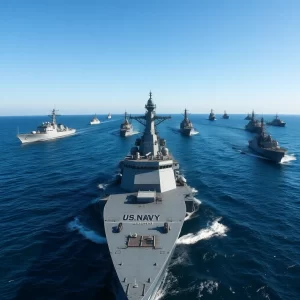
The Australian government has announced an initial investment of $3.9 billion to construct a new submarine shipyard in Osborne, South Australia. This ambitious project is part of a larger $30 billion investment over the coming decades aimed at bolstering Australia’s defence capabilities through the construction of conventionally armed nuclear-powered submarines. The development is expected to create nearly 10,000 jobs, underscoring the strategic importance of Osborne within the AUKUS pact.
Context and Background
This investment in the Osborne shipyard comes amidst a growing interest in enhancing Australia’s maritime defence capabilities, particularly following the signing of the AUKUS trilateral agreement between Australia, the United Kingdom, and the United States. This agreement aims to equip Australia with nuclear-powered submarines, reaffirming its strategic position in the Indo-Pacific region.
Historically, Osborne has been a cornerstone of Australian shipbuilding, with facilities dedicated to the maintenance of the Collins and Hunter class submarines. This new development significantly expands its capacity, raising expectations for submarine production and maintenance to unprecedented levels.
In-Depth Technical Analysis
Challenges and Technical Viability of Construction
The utilisation of 126,000 tonnes of structural steel at Osborne highlights the magnitude of this project. For context, the Eiffel Tower, an iconic feat of engineering, was constructed with 7,300 tonnes of wrought iron. The construction of submarines demands precision and quality in materials, presenting a significant technical challenge for the naval engineers and builders involved.
Furthermore, the manufacture of nuclear-powered submarines will require specialised facilities for the safe handling of nuclear components. This necessitates additional investment in cutting-edge technology and specialised training to ensure the highest safety standards are met.
Economic and Employment Impact
With 10,000 jobs projected, the Osborne shipyard is set to be an economic powerhouse for South Australia. However, this raises the need for a highly skilled workforce. The Skills and Training Academy (STA), expected to commence in 2025, will be crucial in training these workers, offering programmes for up to 1,000 students annually.
The economic impact extends beyond direct employment, also influencing the construction, logistics, and service sectors, thereby creating a multiplier effect within the local economy.
Concrete Operational Implications
Changes for Industry Professionals
The development of the submarine shipyard in Osborne will require new competencies in nuclear engineering and complex project management. Engineers, technicians, and logistics specialists will need to adapt to advanced technologies and international nuclear safety standards.
The construction process will involve the adoption of new manufacturing and assembly methods, demanding specific skills in automation and quality control.
Impact on the Labour Market
The Osborne project will increase demand for professionals in naval engineering, project management, and specialists in nuclear propulsion. Interested individuals should keep an eye on training opportunities at the STA and emerging vacancies in the defence sector.
Geopolitical and Macro-Environmental Context
The Osborne project reinforces Australia’s position as a key player in Indo-Pacific security. The construction of nuclear-powered submarines not only addresses defence needs but also reflects a commitment to regional stability amidst rising geopolitical tensions.
Moreover, the shipyard development is a response to the increasing demand for advanced maritime capabilities, at a time when port congestion and environmental restrictions challenge traditional commercial operations.
Future Outlook
In the short term, the Osborne project promises to revitalise South Australia’s economy. However, its success will depend on the ability to train an adequate workforce and effectively manage the complexities of submarine construction.
Critical factors include the availability of safe nuclear technology and adherence to stringent international standards. The evolution of this project will be a key indicator of Australia’s capacity to assume more prominent roles in regional defence.
FAQ
- How many jobs will the new shipyard create? It is estimated that around 10,000 direct jobs will be created in South Australia.
- What is the environmental impact of the project? While the announcement does not specify, the construction of nuclear submarines entails strict environmental and safety controls.
- When will the Skills and Training Academy begin operations? It is expected to commence in 2025, training up to 1,000 students per year.
This news is based on “Australia announces initial $3.9 billion investment for nuclear submarine shipyard in Osborne” from www.elSnorkel.com, accessible via original link.
Legal Notice: This article is an independent editorial analysis based on public information and technical knowledge of the maritime sector. It does not substitute for consultation with qualified professionals nor does it constitute specific technical, legal, regulatory, or professional advice.
Editorial Note: This article has been professionally adapted from Spanish to British English
for the WishToSail.com international maritime audience. Original article published at
QuieroNavegar.app.