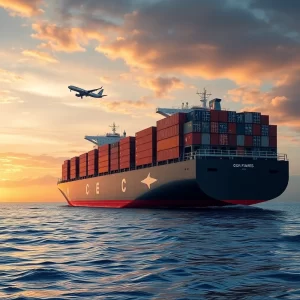
Hapag-Lloyd, the German maritime giant, has announced its acquisition of ZIM Integrated Shipping Services, one of Israel’s leading shipping companies, at a price of $35 per share, valuing the deal at approximately $4.2 billion. This move signifies a significant consolidation within the container shipping industry, which has been affected by fluctuations in demand and changes in environmental regulations.
Context and Background
In recent years, the container shipping industry has witnessed a series of mergers and acquisitions driven by the need to adapt to an increasingly complex operational environment. The pressure to reduce carbon emissions and the volatility in bunker fuel prices have incentivised shipping companies to seek economies of scale. According to the United Nations Conference on Trade and Development (UNCTAD), mergers in this sector have increased market concentration, with the top ten shipping lines controlling over 80% of global capacity.
The acquisition of ZIM by Hapag-Lloyd fits within this trend, allowing the German company to increase its transport capacity and strengthen its position in key markets such as the Mediterranean and Asia.
In-Depth Technical Analysis
Impact on Fleet Capacity and Operational Routes
With this acquisition, Hapag-Lloyd will significantly increase its fleet capacity, integrating ZIM’s fleet, which totals approximately 456,000 Twenty-foot Equivalent Units (TEU). This not only enhances its presence on strategic routes but also allows for optimisation of its logistical operations, reducing operational costs and improving the efficiency of its services.
Furthermore, the integration of ZIM will enable Hapag-Lloyd to access advanced fleet management and route optimisation technologies that ZIM has developed in recent years, including sophisticated monitoring systems and real-time data analytics.
Economic Implications for Shipowners
For shipowners, this consolidation presents both opportunities and challenges. The reduction of players in the market could mean greater stability in freight rates, although it may also limit options for those seeking to diversify their commercial alliances. Additionally, Hapag-Lloyd’s increased bargaining power could influence the terms of charter and maintenance contracts.
Changes for Industry Professionals
This move will have direct implications for maritime professionals. On one hand, an increase in demand for skilled personnel in fleet management and integrated logistics is expected, along with experts in information technology and data analysis. On the other hand, the merger operations could lead to internal restructuring that may affect current employees of both companies.
Impact on the Labour Market
The merger is likely to increase demand for technical profiles such as operations officers and maritime data analysts, particularly those with experience in system integration and logistical optimisation. Interested individuals are encouraged to check emerging job opportunities in our dedicated maritime employment section.
Macro Context
In a geopolitical context where trade tensions and protectionist policies affect global commerce, this acquisition could provide Hapag-Lloyd with a crucial competitive advantage. The diversification of routes and expanded capacity will enable the company to adapt to sudden changes in demand and trade restrictions, ensuring the continuity of its operations in an uncertain environment.
Outlook
In the short term, the integration of ZIM is expected to be smooth, given Hapag-Lloyd’s experience with previous merger operations. However, challenges will lie in harmonising corporate cultures and operational systems. Critical factors include the ability to adapt to emerging environmental regulations and the efficient management of the expanded fleet capacity.
FAQ
- How will this acquisition affect freight rates? Freight rates may stabilise as Hapag-Lloyd optimises its operations and capacities.
- What operational changes are expected following the merger? A restructuring of routes and the integration of advanced fleet management technologies is anticipated.
- What job opportunities may arise from this merger? There will be an increased demand for experts in integrated logistics and maritime data analysis.
This article is based on “Hapag-Lloyd’s $4.2 Billion ZIM Deal Redefines the Landscape of Global Container Shipping” by FAN Transport Insights, accessible at the original link.
Legal Notice: This article is an independent editorial analysis based on public information and technical knowledge of the maritime sector. It does not substitute for consultation with qualified professionals nor does it constitute specific technical, legal, regulatory, or professional advice.
Editorial Note: This article has been professionally adapted from Spanish to British English
for the WishToSail.com international maritime audience. Original article published at
QuieroNavegar.app.