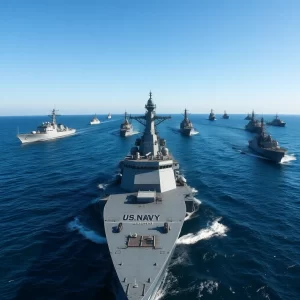
- The US Navy aims to expand its total fleet to 500 vessels, with 150 being Unmanned Maritime Vehicles (UMVs).
- Former Chief of Naval Operations, Admiral Michael Gilday, disclosed this plan at a military-industrial conference.
- Currently, the US Navy operates around 300 active ships, indicating a significant build-up effort.
In a strategic move, the US Navy has unveiled plans to grow its fleet to 500 ships, integrating 150 unmanned vessels. Former Chief of Naval Operations, Admiral Michael Gilday, announced this during a recent conference, highlighting a push towards naval modernisation amid global geopolitical competition.
CONTEXT AND BACKGROUND
The US Navy currently maintains approximately 300 ships in active service. While fleet expansion initiatives are not new, the substantial inclusion of unmanned technology represents a key innovation in naval strategy.
Globally, maritime autonomy is advancing rapidly, with applications in defence and logistics. Nations such as China are enhancing their naval capabilities, spurring a technological race in maritime warfare.
IN-DEPTH TECHNICAL ANALYSIS
Unmanned Maritime Vehicles (UMVs, which are remotely operated or autonomous vessels) enable missions like surveillance and attack without risking personnel. Their adoption depends on progress in artificial intelligence and secure communications.
To reach the 500-ship target, the US Navy must accelerate shipbuilding. This involves contracts with shipyards, potentially revitalising the domestic industry. The proportion of 150 UMVs indicates a focus on advanced operations and operational cost savings.
CONCRETE OPERATIONAL IMPLICATIONS
Operationally, UMVs will reduce crew requirements for routine missions, freeing resources for complex tasks. They will demand new port infrastructures, such as remote control systems and specialised maintenance facilities.
Military port logistics, for example at Pearl Harbor, will need adaptation. This could benefit firms developing support technologies, while traditional ports face modernisation challenges.
IMPACT ON THE LABOUR MARKET
This shift will generate demand for skills in robotics, cybersecurity, and autonomous operations. Mariners will require training in unmanned systems to stay competitive.
For naval engineers and technicians, opportunities will emerge in UMV design and maintenance. The private sector may access development contracts, though investments involve risks and require due diligence.
MACRO CONTEXT
Geopolitically, this expansion responds to competition with China, which seeks to extend its maritime influence. International regulations on autonomous navigation, such as those from the International Maritime Organization (IMO), are evolving and will affect implementation.
Trends like decarbonisation will influence the fleet, as UMVs can incorporate more efficient propulsion. The US Navy might prioritise green technologies in its new vessels.
OUTLOOK
Achieving 500 ships faces budgetary and technological hurdles. Based on historical shipbuilding cycles, it could take a decade or more, depending on funding and advancements.
For investors, defence and maritime technology companies offer opportunities, but with volatility. Global shipyard overcapacity might moderate costs, benefiting efficient contractors.
FAQ
What are Unmanned Maritime Vehicles (UMVs)? UMVs are vessels that operate without onboard crew, controlled remotely or autonomously, used for military missions such as surveillance and reconnaissance.
How will this affect US shipbuilding? It will increase demand for domestic shipyards, potentially revitalising the industry with contracts for both manned and unmanned ships, though timelines and costs are uncertain.
What skills will maritime professionals need? Knowledge in autonomous systems, programming, advanced electronics maintenance, and cybersecurity, with opportunities for specialised training.
Are there precedents for naval fleets with UMVs? Yes, navies like the Royal Navy and the Chinese Navy are experimenting with unmanned vehicles, but on smaller scales, making the US Navy’s plan one of the most ambitious.
Editorial Note: This article has been professionally adapted from Spanish to British English
for the WishToSail.com international maritime audience. Original article published at
QuieroNavegar.app.