


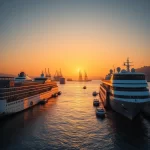


- Port of Tarragona and Euroports commit €80 million to transform Muelle de Baleares into a dedicated floating offshore wind hub, adding 22 hectares and 617 metres of berthing.
- The quay will feature a 23-metre draught, rare in the Mediterranean, enabling heavy-lift and semi-submersible vessel access for large turbine components.
- Operations are set for 2029, with cross-border coordination with Euroports’ Port-la-Nouvelle terminal in France, creating a logistics corridor for floating wind farms.
The Port of Tarragona and Euroports have unveiled a €80 million plan to establish the western Mediterranean’s first hub dedicated solely to floating offshore wind. Announced at the WindEurope 2026 trade fair in Madrid (21–23 April), the project will convert the Muelle de Baleares into a centre for construction, assembly, logistics, and maintenance of floating turbines. The initiative aims to capitalise on deep-water wind potential along Spain’s Mediterranean coast and strengthen the region’s renewable energy supply chain.
Context and Background
Floating offshore wind technology allows turbines to be installed in waters deeper than 50 metres, where fixed foundations are not feasible. The Mediterranean basin, with its narrow continental shelves and deep seabeds, is a prime candidate for this technology. Spain already leads in Europe with pioneering projects such as DemoSATH, a floating turbine operated by Saitec off the Basque coast.
The Tarragona agreement is not an isolated move. Euroports already runs a floating wind terminal at Port-la-Nouvelle in southern France, where turbines are assembled and deployed. The coordination between the two ports creates a cross-border logistics corridor: Port-la-Nouvelle will focus on manufacturing, while Tarragona will handle large-scale assembly and maintenance.
The €80 million investment forms part of the Port of Tarragona’s broader port investment plan, totalling €304 million up to 2029. It also benefits from PORT-EOLMAR subsidies from Spain’s Ministry for Ecological Transition, financed through the European Next Generation recovery fund, reducing public financial risk and accelerating job creation in renewable infrastructure.
In-Depth Technical Analysis
23-Metre Draught: A Genuine Competitive Edge
The Muelle de Baleares expansion will offer a draught of 23 metres, a depth rarely found in Mediterranean ports. Floating wind turbine components—such as blades exceeding 80 metres in length and tower sections—require deep-water quays for loading and unloading. Most Mediterranean ports have maximum draughts of 12 to 15 metres, severely limiting their ability to handle these oversize loads.
With 23 metres, the quay can accommodate heavy-lift vessels and semi-submersible ships, essential for transporting floating turbines. This positions Tarragona as a strategic hub for deploying wind farms in the western Mediterranean, including projects like the Gulf of Fos parks in France and Saitec’s Spanish initiatives.
22 Extra Hectares for Assembly and Logistics
The expansion will add 22 hectares of exclusive floating wind activity space, including storage, pre-assembly areas, maintenance workshops, and berths. Logistics planning is critical: floating turbines are assembled on land and towed to their final offshore positions, making quayside space a key efficiency factor.
Euroports brings operational expertise from Port-la-Nouvelle, where three floating turbines have already been built and integrated, with plans for three more. Coordination with Tarragona will allow production scaling and lower logistics costs, a decisive factor for project viability.
Concrete Operational Implications
Centralising assembly and maintenance at one port reduces transit times and transport costs. Regional specialisation lets each port focus on its strengths: manufacturing in France, assembly in Spain. For shipowners and operators, this means more efficient routing for heavy-lift vessels moving components between the two ports, cutting fuel consumption and emissions. New opportunities will also emerge for maritime service companies, including tugboats, support vessels, and maintenance platforms.
Impact on the Labour Market
The hub is expected to generate hundreds of direct and indirect jobs, from assembly workers to maintenance engineers, port logistics specialists, and project managers. Most in-demand profiles will include experience in onshore and offshore wind turbine installation, plus additional skills in dynamic anchoring systems, submarine cables, and floating structures—a niche with currently low competition.
Cross-border labour mobility with Port-la-Nouvelle will allow Spanish technicians to work temporarily in France and vice versa, fostering knowledge transfer. Training providers, such as nautical vocational centres and naval engineering universities, should develop specific floating wind courses to meet this demand.
Macro Context: Geopolitics, Regulation, and Trends
The EU has set ambitious renewable energy targets for 2030, with offshore wind playing a key role. The Mediterranean’s high population density and energy demand make it a priority region for floating wind deployment. The war in Ukraine has accelerated Europe’s energy transition away from Russian fossil fuels, and floating wind opens possibilities for Spain, France, Italy, and Greece, which have extensive offshore wind potential.
Spain’s Climate Change and Energy Transition Law sets binding emission reduction targets, and offshore wind is expected to contribute substantially. The PORT-EOLMAR aids exemplify how public funds can catalyse private investment in renewable infrastructure.
Outlook
The Muelle de Baleares expansion will be operational by 2029, but early effects will be felt sooner. Euroports is already coordinating logistics with Port-la-Nouvelle, and the first floating turbines are expected to begin assembly in Tarragona by 2027. By then, the first Spanish Mediterranean floating wind farm—currently in planning—could be under construction.
Longer term, Tarragona could become a reference hub for the entire Mediterranean region, attracting international investment and fostering an industrial ecosystem around floating wind. Success will depend on coordination among ports, administrations, and companies, as well as training of skilled professionals. For investors, the sector offers attractive opportunities but carries risks: technology is maturing fast, but installation and maintenance costs remain high. Public support and growing clean energy demand suggest positive prospects, though each investor should conduct their own due diligence.
Editorial Note: This article has been professionally adapted from Spanish to British English
for the WishToSail.com international maritime audience. Original article published at
QuieroNavegar.app.