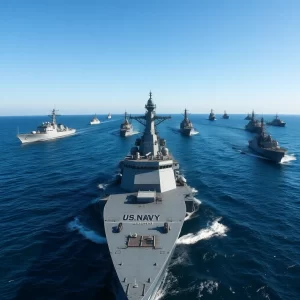
- A US Navy submarine sank an Iranian battleship in the Indian Ocean on Tuesday, causing at least 87 fatalities.
- This is the first torpedo attack by a US submarine since World War II, reviving historical naval tactics after decades.
- Former nuclear submarine commander David Marquet notes regular practice with exercise torpedoes to maintain combat readiness.
On Tuesday, a United States Navy submarine launched a torpedo that destroyed an Iranian battleship in the Indian Ocean, resulting in the deaths of at least 87 sailors. This event marks the first instance since World War II where the US has used a submarine to sink an enemy warship, highlighting heightened maritime tensions in a strategic region. The attack underscores the evolving role of submarines from peacetime surveillance to direct combat, as insights from ex-commander David Marquet reveal.
Context and Background
Since World War II, the US Navy has primarily focused submarine operations on nuclear deterrence and intelligence gathering, moving away from direct attacks on battleships. The submarine force, often called the Silent Service, has evolved to prioritise stealthy surveillance over overt engagements in recent decades.
This incident recalls historical tactics from the Pacific campaigns of the 1940s, where torpedoes were extensively used. Current geopolitical frictions in the Indian Ocean, with sustained US and Iranian military presence, have increased the risk of such escalations, making this attack a significant departure from post-war norms.
In-Depth Technical Analysis
Exercise torpedoes are subsurface training munitions without live warheads, used for regular drills in the US fleet. According to Marquet, all submarines conduct multiple annual launches to practise end-to-end systems, ensuring operational precision when real attacks are needed.
In peacetime, submarines operate silently, often integrated into carrier strike groups to collect intelligence and monitor adversary patterns. This passive surveillance capability is crucial for deterrence, allowing undetected observation of movements.
During conflicts, their role expands to include sinking vessels and launching missiles, such as Tomahawk cruise missiles. The transition from training exercises to actual combat demonstrates the effectiveness of rigorous preparedness in maritime defence strategies.
Concrete Operational Implications
This event emphasises the critical importance of continuous training in submarine forces. Regular practice with exercise torpedoes ensures crews can execute precise attacks in real scenarios, minimising errors during engagements.
Operationally, the anonymity of the involved submarine—kept confidential for security reasons—protects tactical capabilities and stealth methods. This standard practice in sensitive military operations limits enemy abilities to counterattack or adapt defences, maintaining strategic advantage.
Impact on the Labour Market
Incidents like this may boost demand for professionals in naval sectors. Job opportunities could increase for submariners, naval engineers specialised in torpedo systems, and cybersecurity experts focused on securing underwater communications.
Training at maritime institutions and military programmes becomes more relevant, offering pathways for careers in defence. However, any investment in this field carries risks and should be based on personal research, given the volatile nature of geopolitical events.
Macro Context
Geopolitically, this attack occurred in the Indian Ocean, a region with key commercial shipping routes and frequent tensions between global powers. International maritime law, such as the United Nations Convention on the Law of the Sea (UNCLOS), might be challenged by direct military actions, affecting regional maritime security.
Trends towards increased militarisation in international waters could accelerate, influencing defence policies of other nations. This reflects a scenario where deterrence fails, leading to open confrontations that disrupt global trade and stability.
Outlook
Looking ahead, the US submarine force is likely to maintain its focus on intensive training and dual roles, balancing deterrence with offensive capabilities. As Marquet indicates, the hope is that deterrence prevents further attacks, but this event suggests a potential rise in active operations.
Innovation in underwater technology, such as more stealthy torpedoes or advanced detection systems, could gain momentum, offering opportunities for developments in the maritime-defence sector. This may drive research and investment in next-generation naval assets.
FAQ
What are exercise torpedoes?
Exercise torpedoes are underwater projectiles used in training, designed without real explosives to simulate launches and test systems safely, allowing regular fleet practices without causing damage.
How do submarines operate during peacetime?
In peacetime, submarines conduct silent surveillance, gathering intelligence and monitoring enemy operational patterns, often while integrated into carrier groups to maintain a deterrent presence without detection.
Why is the specific submarine involved not disclosed?
For military security reasons, to protect operational capabilities, stealth tactics, and prevent enemy counterattacks or identification, which is standard in classified naval operations.
What does sinking a battleship imply for modern naval warfare?
It highlights the continuity of traditional tactics like torpedo attacks combined with advanced technology, reinforcing submarines as strategic assets for both intelligence and direct combat in contemporary conflicts.
Editorial Note: This article has been professionally adapted from Spanish to British English
for the WishToSail.com international maritime audience. Original article published at
QuieroNavegar.app.