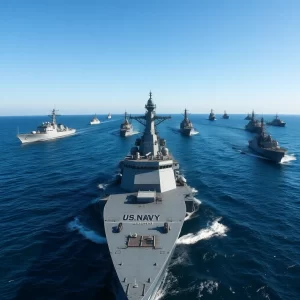
- US Navy transitions from regional commands to coordinated presence in Atlantic, Pacific, Indian, and Arctic Oceans.
- Requires vessels with greater autonomy, such as Arleigh Burke-class destroyers and Nimitz-class aircraft carriers, for extended deployments.
- Creates opportunities in naval shipbuilding and specialised personnel training, impacting port logistics and commercial maritime sectors.
The United States Navy is currently redefining its global maritime strategy to maintain a coordinated presence across the Atlantic, Pacific, Indian, and Arctic Oceans. This strategic shift, driven by the need to address transoceanic threats, moves beyond traditional geographical boundaries. It has significant implications for the wider maritime industry, from logistics to shipbuilding.
CONTEXT AND BACKGROUND
Historically, US naval operations have been structured around defined regional theatres. These include commands like the Indo-Pacific or Europe under the Department of Defense. This approach has facilitated bureaucratic management but may hinder responses to cross-ocean challenges. In the maritime sector, similar patterns exist, with fleets often assigned to specific operational zones.
IN-DEPTH TECHNICAL ANALYSIS
Vessel Requirements and Autonomy
A four-ocean strategy necessitates vessels with enhanced autonomy and versatility. Ships like the Arleigh Burke-class destroyers (guided-missile destroyers designed for multi-mission roles) and Nimitz-class aircraft carriers (nuclear-powered carriers with global reach) must operate in diverse environments. This demands advanced propulsion and communication systems to sustain long-distance deployments without constant port access.
Logistics and Maintenance Challenges
Extended deployment distances complicate maintenance cycles and resupply. Vessels will navigate longer routes, requiring optimized supply chains for spare parts and fuel. Interoperability (the ability of different naval forces to operate together) becomes crucial for joint exercises and securing key commercial routes, such as those in the Arctic.
CONCRETE OPERATIONAL IMPLICATIONS
Port operators may see increased warship traffic at strategic hubs like Norfolk or San Diego. This necessitates infrastructure upgrades and enhanced security protocols. In logistics, supply chains for defence cargo must be streamlined, benefiting specialised shipping firms. Commercial shipowners could face competition for congested routes but gain opportunities in defence support contracts.
IMPACT ON THE LABOUR MARKET
There will be higher demand for naval officers skilled in multi-theatre operations and advanced technologies. Training institutions, such as the US Naval Academy, may emphasise oceanic navigation and maritime diplomacy. In the private sector, naval engineers and port logistics specialists will find roles in fleet modernisation projects, potentially revitalising shipbuilding for versatile vessels.
MACRO CONTEXT
Geopolitically, this aligns with competition from China and Russia, who are expanding fleets in the Indian and Arctic Oceans. Global regulations, like those from the International Maritime Organization (IMO) on emissions, push for more efficient ships. Trends such as Arctic ice melt are opening new trade routes, making naval presence there strategically vital for security and economic interests.
OUTLOOK
Short-term implementation depends on budget allocations and political consensus, with challenges in funding new constructions and training programmes. Long-term, this could redefine global naval operational standards, driving innovations in areas like propulsion and communications. For investors, sectors like naval construction and maritime technology show potential, but decisions should be based on thorough research due to inherent risks.
FAQ
What is a four-ocean navy strategy? It is a naval approach aimed at maintaining a constant, coordinated presence in the Atlantic, Pacific, Indian, and Arctic Oceans, overcoming traditional geographical divisions to address global threats.
How does this differ from the current US Navy structure? Currently, the US Navy operates through regional commands with rigid boundaries. A four-ocean strategy emphasises flexibility and the ability to project power across multiple theatres simultaneously, optimising resources and logistics.
What are the implications for international maritime security? This could enhance stability on key commercial routes by deterring threats like piracy, but may also increase tensions in regions with dense naval presence. It requires greater cooperation with allies for joint patrols and exercises.
How will this affect commercial vessels and port operations? Ports may experience more naval traffic, needing infrastructure adaptations. Commercial ships could benefit from improved route security but might compete for space in strategic ports during military operations.
Editorial Note: This article has been professionally adapted from Spanish to British English
for the WishToSail.com international maritime audience. Original article published at
QuieroNavegar.app.