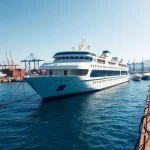


Revolutionizing Emissions: The Future of LNG with Brittany Ferries
In a groundbreaking move that is reshaping the landscape of maritime emissions in Europe, Brittany Ferries has unveiled the results of a 12-month independent study revealing that methane emissions from its LNG-powered vessel Salamanca are 50% lower than estimated by current regulations. This finding, a result of collaboration with French scientists and the national ecological agency ADEME, challenges long-held assumptions about LNG emissions and encourages a new perspective on how innovation in energy transition should be acknowledged.
The study, led by Benoît Sagot, a researcher at ESTACA, focused on real-time monitoring of emissions from the Salamanca, one of Brittany Ferries’ four LNG-powered vessels. The research spanned a full year of operations on the Rosslare–Bilbao and Rosslare–Cherbourg routes, observing methane leakage, i.e., unburned methane released during combustion. The results, published in the Journal of Marine Science and Engineering, show that methane leakage was recorded at 1.57%, significantly below the default value of 3.5% used in European Union regulations under the FuelEU Maritime framework and the Emissions Trading System (ETS).
Implications for Regulation and Sustainability
Christophe Mathieu, CEO of Brittany Ferries, has openly discussed the broader implications of these findings, especially regarding regulatory equity and innovation. Mathieu emphasizes the need for regulations to reflect operational reality to avoid penalties for “ghost emissions.” He argues that the data obtained shows that actual emissions from their LNG-powered vessels are significantly lower than initially feared and should be integrated into regulatory declarations. This data-driven approach could form the basis of future European and international policies.
- Penalties based on outdated data pose a serious problem for many shipowners.
- Regulations should be updated to reflect actual vessel performance improvements.
- Brittany Ferries’ significant investment in LNG as a cleaner fuel should be properly recognized in the regulatory framework.
LNG as a Transition Fuel
Liquefied Natural Gas (LNG) has been touted as a transitional fuel for the maritime sector, offering a cleaner alternative to conventional heavy oils. However, methane leakage has been a central concern due to methane’s higher global warming potential. This new set of data reinforces confidence in modern LNG technologies, showing that designs of newer vessels can perform significantly better than historical averages. This breakthrough not only provides a new basis for policies and taxation but also reaffirms the role of LNG as a legitimate bridge on the path to decarbonization.
A Call for Science-Based Regulation
As the shipping industry works to comply with stricter European environmental regulations, the accuracy of emission data becomes increasingly important. Default emission factors, while useful for standardization, may not reflect advances in actual vessel performance. Brittany Ferries’ message is clear: regulation based on data can support both climate goals and ongoing investment in low-emission technologies. The company is open to hosting follow-up studies using their LNG-powered vessels, marking a collaborative path forward.
Relevance for the Maritime Sector
This breakthrough is significant for all stakeholders in the maritime sector, from fuel providers to ship operators and policymakers. The findings validate what many in the LNG space have long claimed: modern LNG vessels can, and indeed do, perform much better than assumed. The relevance of this discovery is clear for merchant marine professionals and maritime investors. The study results offer a new benchmark for emissions regulation based on real operational data, support the role of LNG as a low-carbon fuel, and fairly acknowledge sustainability innovation in the political landscape.
- The study results offer a new benchmark for emissions regulation based on real operational data.
- Support the role of LNG as a low-carbon fuel.
- Acknowledge sustainability innovation in the political landscape.
Final Thoughts
Brittany Ferries’ leadership in supporting research sets an important precedent. As maritime transport navigates the complexities of climate compliance, the way forward must be based on verified performance, technological progress, and a shared commitment to transparency. Achieving the goal of net-zero emissions will require not only better fuels but also better regulatory frameworks. This begins by ensuring that those investing in cleaner maritime transport technologies are assessed based on the emissions they actually produce, not estimates from a decade ago.