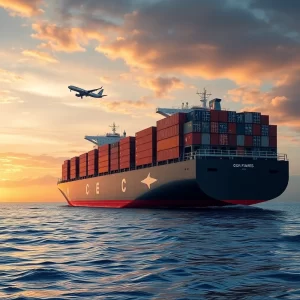
The Milestone of Sustainable Maritime Decarbonization
The maritime sector is undergoing a transformation towards a more sustainable future. This article explores a historic milestone in this transformation: the first verified transfer of Sustainable Marine Fuel (SMF) Certificates led by Hapag-Lloyd, the Zero Emission Maritime Buyers Alliance (ZEMBA), and the digital platform Katalist. This advancement represents a crucial step in global maritime transport decarbonization, providing professionals and investors with insights into the innovations reshaping the industry.
An Innovative Milestone in Maritime History
For the first time in history, the verified transfer of Sustainable Marine Fuel Certificates has been achieved. This achievement, using a ‘book & claim’ system, allows for the independent verification and allocation of emission reductions regardless of the physical use of the fuel. This approach not only sets a scalable and traceable precedent for global maritime transport decarbonization but also opens new opportunities for companies and industry professionals.
- The collaboration between Hapag-Lloyd, ZEMBA, and Katalist demonstrates the significant emission reductions possible through the use of certified biomethane from waste.
- This verified system offers real and measurable emission reductions, rather than offsets, representing a real advancement towards corporate decarbonization goals.
For industry professionals, this development is not just a technological advancement but also an opportunity for employment and specialization in a growing area. The possibility of submitting resumes to the companies involved can open doors to innovative projects focused on maritime sustainability.
The Role of Hapag-Lloyd, ZEMBA, and Katalist
Hapag-Lloyd, with its operational capacity, has been instrumental in this achievement, using certified biomethane on selected voyages. ZEMBA, a coalition of environmentally committed cargo owners, has ensured the demand for sustainable shipping services, while Katalist has provided the digital infrastructure to validate, record, and distribute emission savings through a reliable ‘book & claim’ system.
- Transparency and verification are key elements of this initiative, allowing cargo owners to confidently claim emission reductions within a system built for trust and clarity.
- As a result, 17 ZEMBA members are collectively avoiding over 82,000 metric tons of CO₂e emissions in two years of low-emission shipping.
This is not just a pilot; it is a functional large-scale system with third-party verification, designed for global replication.
The Importance of this Breakthrough for the Future of Maritime Transport
The maritime transport industry accounts for nearly 3% of global emissions, and decarbonizing this sector is one of the greatest environmental challenges. The introduction of clean fuels and a verified system to link fuel use with cargo owners’ demand represents a significant advancement in this challenge.
- This achievement is not only a symbol of progress but also offers a scalable model for carriers to offer low-carbon services.
- It allows cargo owners to credibly meet their emission reduction goals, driving the market towards cleaner and contractual supply chains.
With tightening regulations and increasing sustainability expectations, this approach could become the norm, offering a scalable pathway to zero-emission maritime transport that benefits both operators and their customers.
Future Perspectives: A Model to Follow
Following the successful initial transfer, the maritime industry has crossed a significant threshold, not only in ambition but also in execution. The reality of clean fuels, verified emissions, and value delivered to those leading the change is now in sight. This model is not only applicable to large corporations but can also benefit small and medium-sized enterprises looking to stand out on the path to corporate sustainability.
- The opportunities to reduce carbon footprint and actively participate in initiatives prioritizing the environment are increasingly accessible to all industry players.
- We invite readers to explore more about these innovations and consider how they can integrate them into their work or investment practices.
Conclusions: The Value of Innovation and Collaboration
This advancement in decarbonizing maritime transport highlights the importance of innovation and collaboration in the industry. For maritime professionals, sailors, and maritime investors, understanding and engaging in these innovations is crucial to staying relevant in an evolving market.
- The job and investment opportunities in the maritime sector are increasingly focused on sustainability.
- The technologies and business model introduced by Hapag-Lloyd, ZEMBA, and Katalist not only meet environmental goals but also offer a competitive advantage in a global market that increasingly values responsible business practices.
As more industry players adopt these models, the maritime sector will not only reduce its environmental impact but also open new avenues for business and growth. This is an exciting time to be part of a transformation that promises to redefine the future of global maritime transport.